EUR
EUR USD
USD JPY
JPY GBP
GBP CNY
CNYHow Much Should a Power Strip Cost? A Guide to Power Strip Prices
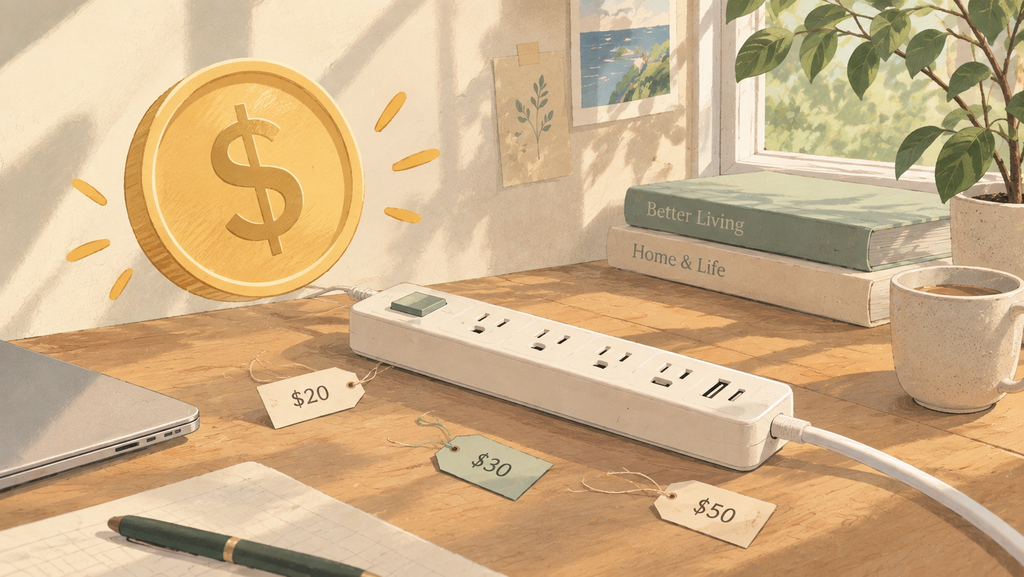
How much should a power strip cost?
You can find basic models for less than $10, while others cost $30, $50, or even more. At first glance, they may all seem to do the same thing: plug into a wall and give you more outlets.
So why the price difference?
The answer is that you are not always paying for more sockets. You may be paying for better materials, more thoughtful construction, higher power ratings, USB-C charging, better outlet spacing, a longer cable, or simply a design that is meant to become part of your space rather than something hidden underneath it.
The right question is not:
“What is the cheapest power strip?”
It is:
“What should I expect to get at each price?”
What Is the Average Price of a Power Strip?
There is no single standard price for a power strip because the category covers a wide range of products.
A basic model for occasional use and a premium desk power strip designed for a modern workspace may look similar at first, but they are built with very different priorities.
As a general guide, power strips usually fall into these price ranges:
| Price range | What you may find | Best for |
|---|---|---|
| Under $15 | Basic outlets and simple housing | Occasional or basic use |
| $15–$25 | Everyday models with some additional features | Basic home and desk use |
| $25–$40 | A wider range of everyday models with different materials, layouts, and features | Desks and home offices |
| $40+ | Premium or specialized features | Specific or advanced setups |
These ranges are not strict rules.
A $20 power strip can sometimes be a better choice than a $50 model, depending on what you actually need.
Price is only a starting point. The specifications tell you what you are really buying.
Under $15: The Basic Option
At the lower end of the market, power strips are usually designed around one simple goal:
Provide additional outlets at a low cost.
You may get:
- Several AC outlets
- A standard power cable
- A basic plastic housing
- A simple on/off switch
For a simple setup, this may be completely sufficient.
A bedroom lamp, phone charger, or a few low-power devices do not necessarily require a premium power strip.
The trade-off usually appears in areas such as:
- Material quality
- Outlet spacing
- Cable length
- Physical design
- Additional functions
If you only need a basic connection point and the product will stay hidden behind furniture, spending more may not provide much practical benefit.
$15–$25: The Everyday Basic
Moving into the $15–$25 range, you will generally find more variety.
Power strips in this range may include:
- Improved housing materials
- Better outlet layouts
- USB charging
- Longer cables
- More practical designs
For a simple home office or everyday desk setup, this can be a reasonable place to start.
However, this is also where comparing specifications becomes more important.
Two power strips with a similar price tag can be completely different products.
One may focus on providing the maximum number of AC outlets.
Another may offer fewer outlets but include USB-C charging, better spacing, or a design that takes up less desk space.
The question is not simply how many features a product has.
The question is whether those features solve your actual problems.
$25–$40: More Variety to Compare
The $25–$40 range includes a wide variety of everyday power strips.
At this level, products often begin to focus more on details that affect long-term use:
- Materials
- Construction quality
- Electrical specifications
- Outlet layout
- Charging options
- Overall usability
Depending on the model, you may find features such as:
- USB-C charging
- Better outlet spacing
- Longer cables
- Higher electrical ratings
- Flame-retardant housing materials
- More compact or specialized designs
- Better switches and internal construction
However, a higher price does not automatically mean a better product.
Two products in the same price range can make very different choices in design, materials, and features.
For a desk or home office that you use every day, it is worth comparing these details instead of choosing only by price.
$40 and Above: When Does It Make Sense?
A power strip costing more than $40 is not necessarily overpriced.
At this level, you should simply have a clear reason for paying more.
Higher-priced models may include:
- Specialized mounting systems
- Smart controls
- Advanced charging features
- Premium materials
- Professional workspace designs
Some are made to be mounted under desks.
Others are designed for specific equipment setups or environments.
If those features solve a real problem for you, the extra cost may be worthwhile.
But if you only need to power a laptop, lamp, and phone charger, spending significantly more may not provide much additional value.
What Actually Makes a Power Strip More Expensive?
Price differences usually come from a combination of factors rather than one single feature.
1. Materials
The outer housing is more important than it may seem.
Engineered plastics and flame-retardant materials usually cost more than basic plastic while offering different levels of heat resistance, durability, and flame performance.
When comparing products, look for specific material information rather than vague descriptions such as “premium quality.”
For example, a housing with a UL94 V-0 flame-retardant rating provides more useful information than simply saying the product uses “high-quality plastic.”
2. Electrical Rating
A power strip’s rated electrical capacity is another important specification.
For example, a model rated at 16A and 3,680W is designed for a different electrical load compared with a lower-rated product.
That does not mean the highest rating is always the right choice.
The better approach is choosing a product that matches your electrical system and the devices you plan to use.
3. Outlet Layout
More outlets do not always mean more usability.
Large adapters can block neighboring sockets when outlets are positioned too closely together.
Better spacing allows more outlets to remain usable at the same time.
This is one of those details that is easy to overlook when shopping online but immediately noticeable during everyday use.
4. USB-C Charging
USB-C charging can also affect the price.
A power strip with USB-C ports can reduce the need for separate charging adapters for some devices.
For modern desk setups, this can be a useful addition.
But remember: you are paying for a function.
If you never use USB-C charging, there is little reason to pay extra for it.
5. Cable Length
A longer cable can increase cost, but it can also improve flexibility.
A 2m cable, for example, gives more freedom when your desk is not directly next to a wall outlet.
The ideal cable length depends on your space.
Too short limits placement options. Too long can create unnecessary cable clutter.
Design Can Be Part of the Value
There is another factor that is harder to measure:
Design.
Traditional power strips are usually designed to disappear.
They are placed:
- Behind furniture
- Under desks
- Along walls
But a power strip does not always need to be hidden.
A vertical tower power strip uses vertical space instead of spreading across the desk surface. This can be useful for smaller workspaces where every inch matters.
When a power strip stays visible every day, its:
- Shape
- Proportion
- Finish
- Color
can become part of the environment.
At that point, you are not only buying electrical functionality.
You are also choosing an object that interacts with your workspace.
Cheap vs. Expensive: What Are You Really Paying For?
The difference between a cheap and expensive power strip is not simply:
More money = better product
A better way to think about the price is understanding what you are actually paying for.
| What you are paying for | Why it matters |
|---|---|
| More outlets | Useful for larger setups |
| Higher electrical rating | Supports different power requirements |
| Better materials | Improves durability and flame performance |
| Better outlet spacing | Makes more outlets practically usable |
| USB-C charging | Reduces the need for separate chargers |
| Longer cable | Gives more placement flexibility |
| Better construction | Improves everyday reliability |
| Better design | Matters when the product stays visible |
The goal is not to find the product with the most features.
It is to find the features that actually improve your daily use.
So, How Much Should You Spend?
For basic household use, you can certainly find power strips for less than $25.
If you are looking for something for a desk or home office, $25–$40 is a price range worth considering. You will find a variety of models in this range, from straightforward multi-outlet designs to products with USB-C charging, improved outlet spacing, different housing materials, or more specialized forms.
That does not mean a $25 power strip is automatically better than a $40 one — or that spending more guarantees better quality.
Instead, use the price as a starting point and compare what you are actually getting.
Look at:
- Electrical rating
- Materials
- Cable length
- Outlet spacing
- Charging features
- Overall construction
Then decide which differences actually matter for your setup.
A Simple Power Strip Price Guide
| Price range | What you may find |
|---|---|
| Under $15 | Basic models for simple or occasional use |
| $15–$25 | Everyday models with basic additional features |
| $25–$40 | A wider range of everyday models with different materials, layouts, and features |
| $40+ | Premium or specialized models |
These are only general price ranges.
Actual prices vary depending on country, brand, specifications, and features.
A $30 power strip with poor outlet spacing may be less useful for your desk than a simpler $20 model. Likewise, a $45 model may make sense if its additional features solve a specific problem.
The goal is not to find the most expensive power strip.
It is to find the one that offers the right balance of:
- Electrical capacity
- Materials
- Features
- Construction
- Design
for your needs.
The Cheapest Power Strip Is Not Always the Best Value
A power strip is one of those products that is easy to buy based on one number:
Price.
But the cheapest option can become frustrating if:
- The cable is too short
- The outlets are too close together
- The construction feels weak
- The design does not fit your space
At the same time, paying twice as much does not automatically provide twice the value.
For most desk and home setups, $25–$40 is one price range worth comparing, but specifications and usability matter more than the number on the price tag.
Choose based on what you actually need.
Because in the end, you are not only buying a row of outlets.
You are buying a small improvement to the way you use your space every day.
A Power Strip Designed for Modern Workspaces
As more people work, create, and spend time at their desks, everyday objects are becoming part of the workspace itself.
A power strip no longer has to be something hidden behind furniture.
MiaoLab Tower Power Strip is designed around this idea: a power solution that combines practical function with a more considered desktop form.
Its vertical structure helps reduce horizontal desk clutter while keeping outlets and charging ports easier to access. Available in different regional versions, including US, UK, EU, Japan, and Germany standards, it is designed for different home and office environments.
With features such as multiple AC outlets, USB-C charging, and a V-0 flame-retardant housing, it focuses on the details that influence everyday use — from cable organization to how naturally the product fits into your space.
Because the value of a power strip is not only measured by how many outlets it provides.
It is also measured by how well it fits into your daily routine.
A power strip should not simply add more places to plug things in.
The right one should make your workspace easier, cleaner, and more comfortable to use.
The best value is not necessarily the lowest price.
It is paying for the things you will actually use.
-
Publicado en
power strip price, smart buying, tower power strip, USB-C Power Strip