EUR
 USD
 JPY
 GBP
 CNY
 AED
 SAR
One Outlet, Two Receptacles: Why Independent Control Matters
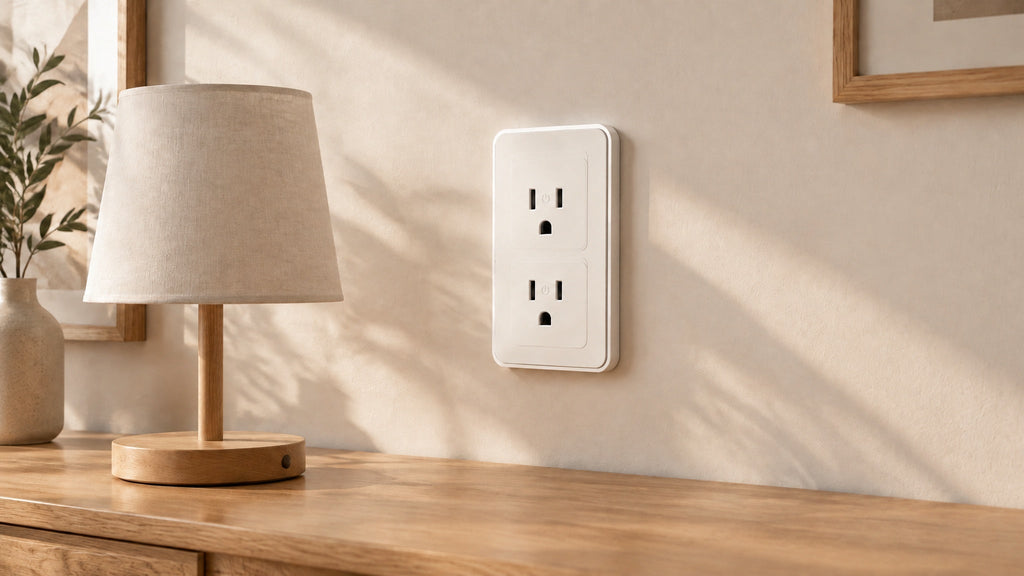
A standard wall outlet may look simple, but its two receptacles often serve different purposes throughout the day.
One might power a desk lamp, while the other connects a phone charger. In a living room, one receptacle may be used for a television and the other for a smaller device. Although they share the same outlet, the devices connected to them do not necessarily need to operate in the same way.
This raises an interesting question: why should two receptacles always be treated as one?
Independent control offers a different approach, allowing each receptacle to respond separately rather than treating the entire outlet as a single unit.
What Does Independent Outlet Control Mean?
A typical duplex wall outlet contains two receptacles within one wall plate.
In many conventional installations, both receptacles are continuously powered by the same circuit. They provide two connection points, but that does not necessarily mean each one has its own switching capability.
An independently controlled outlet takes a different approach.
It allows the power state of each receptacle to be managed separately. Depending on the product design, one receptacle can remain powered while the other is switched off.
The key distinction is simple: two receptacles do not always have to behave as one.
Why Does Independent Control Matter?
1. Different Devices Have Different Needs
Not every connected device needs to be powered at the same time.
For example, a desk setup might include a monitor, a lamp, and a phone charger. Some devices are used continuously, while others are only needed occasionally.
Independent control can provide more flexibility when managing these connections.
2. One Receptacle Can Respond Without Affecting the Other
Imagine a dual-receptacle outlet where one connection is being used by a device that needs continuous power.
With independent control, the other receptacle can be switched separately without automatically interrupting the first.
This is particularly useful in situations where different devices share one wall outlet but have different operating needs.
3. More Flexible Power Management
Independent switching can make outlet management more adaptable.
Rather than treating a duplex outlet as a single power point, each receptacle can have its own operating state. This creates opportunities for more responsive designs and additional safety-related functions.
However, independent control does not increase the electrical capacity of the outlet. The total connected load must still remain within its rated limits.
Independent Control vs. Conventional Dual Outlets
| Feature | Conventional Dual Outlet | Independently Controlled Outlet |
|---|---|---|
| Two receptacles | Yes | Yes |
| Separate power control | Depends on installation and design | Yes, if supported by the product |
| One receptacle can remain powered while the other is switched off | Not typically in standard configurations | Yes |
| Flexible power management | Limited | More flexible |
| Total circuit capacity | Determined by circuit rating | Still limited by rated capacity |
The distinction is not about having more plug openings. It is about having more control over how those openings operate.
How Does Radar Guard Use Independent Control?
MiaoLab Radar Guard Smart Outlet combines two independently controlled receptacles with radar-based proximity detection.
Each receptacle has its own relay control, allowing the outlet to manage its two power connections independently.
When the radar system detects a nearby person or object under the product's operating conditions, it can interrupt power to the relevant receptacle. The other receptacle can continue operating independently.
This means the outlet does not have to treat both connections as a single unit.
The design combines independent power management with an additional layer of proximity-based protection, while retaining a familiar dual-receptacle format.
What Should You Consider Before Choosing an Outlet?
Independent control can be useful, but it is only one part of the overall design.
Before choosing an in-wall outlet, consider:
- Rated capacity: Check the voltage, current, and maximum load supported by the product.
- Independent operation: Confirm whether the two receptacles can actually be controlled separately.
- Safety features: Understand what each protection mechanism is designed to do.
- Installation requirements: Make sure the product is compatible with the existing electrical box and wiring.
- Certifications: Look for relevant safety certifications and compliance with local electrical codes.
For Radar Guard, the rated input is 125 VAC, with a maximum combined current of 15 A and a maximum resistive load of 1,875 W. The two receptacles share this overall rating; independent control does not mean each one has a separate 15 A capacity.
Installation must be performed by a qualified electrician.
A Small Change in Outlet Design, More Flexible Control
A wall outlet may occupy very little space, but it plays an important role in how we use electricity throughout the day.
Independent control introduces a more flexible way to manage two receptacles within one outlet. Instead of treating every connection as part of the same power state, it allows each one to respond separately.
For modern homes, this is a useful step toward more adaptable electrical design.
The Bottom Line: Two receptacles do not always need to operate as one. Independent control makes it possible to manage power more flexibly, while the outlet's overall electrical rating and other safety requirements still apply.
Electrical products must be installed according to applicable local codes by a qualified electrician. Radar Guard is intended for indoor dry locations only. It provides an additional layer of protection and does not replace GFCI, AFCI, or circuit breaker protection.