EUR
 USD
 JPY
 GBP
 CNY
 AED
 SAR
How Does Radar Proximity Detection Work in a Wall Outlet?
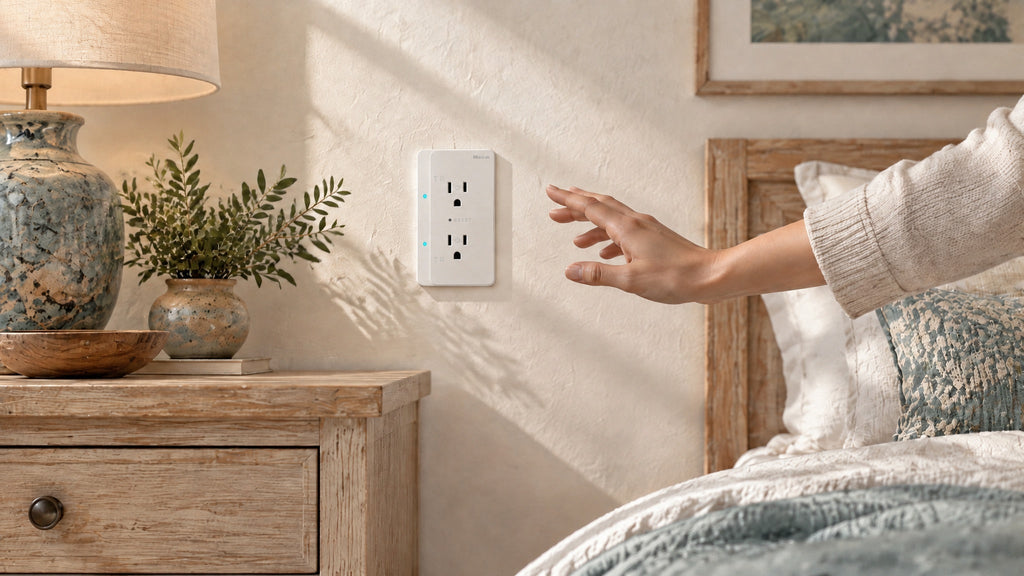
A wall outlet is usually treated as a passive part of a room: it supplies power when a compatible plug is inserted, and it does not otherwise respond to what is happening nearby. Proximity detection introduces a different idea. Instead of relying only on a physical plug or a manual switch, a device can use a sensor to detect that something is close and respond according to its design.
To understand this concept, it helps to separate three ideas: sensing, decision-making, and response. A sensor gathers information. Control logic evaluates that information against defined conditions. A switching component then carries out the intended action. Each stage has its own capabilities and limitations.
A sensor gathers information.
Control logic evaluates that information against defined conditions.
A switching component then carries out the intended action.
What is proximity detection?
Proximity detection refers to identifying that a person or object is within a particular area or distance. Different systems use different sensing methods, including infrared, optical, capacitive, ultrasonic, and radio-frequency technologies. Their performance depends on the sensor design, the target, the environment, and the way the system interprets the signal.
Proximity detection does not necessarily mean identifying who or what is present. A system may only determine that a target appears within its detection zone. The exact information available depends on the technology and the product.
How does radar sensing work?
Radar-based sensing transmits radio-frequency energy and evaluates signals that return after interacting with nearby objects. Changes in the returned signal can provide information that a system uses to detect presence or movement. The sensor and its control logic are designed around a particular frequency, field of view, detection range, and response behavior.
A compact radar sensor can be integrated into a product without requiring a camera or a visible scanning mechanism. However, the word “radar” alone does not tell you how accurately a product detects a target or how it behaves in every situation. Those details must be established through the product's specifications and testing.
From detection to response
Radar Guard combines proximity detection with load detection to determine when power should remain on or be interrupted.
| Step | What Happens | System Response |
|---|---|---|
| 1. Continuous Scanning | The built-in 10 GHz radar continuously scans the area around the outlet. | The system monitors for nearby people or objects within its detection range (up to 30 cm). |
| 2. Proximity Detected | A person or object enters the detection zone. | The system checks the corresponding receptacle's load status. |
| 3. Load Detection | The current detection module checks whether the connected load exceeds the 10 mA threshold. | The system determines whether the receptacle has a valid active load. |
| 4. Power Interruption | Proximity is detected and the corresponding receptacle does not have a valid active load. | The relay cuts power to that receptacle. |
| 5. Power Restoration | The nearby person or object moves away. | Power is automatically restored after approximately 3 seconds. |
An important distinction: Radar detection and load detection work together. A valid connected load can remain powered, while an unused receptacle can have its power interrupted when proximity is detected. Each receptacle operates independently.
Why might this matter at home?
Electrical outlets are often installed low on walls and in places people pass or work near every day. A proximity-aware design explores whether an outlet can respond to nearby activity rather than remaining entirely passive. The relevant question is how the system behaves under defined conditions—not whether the presence of a sensor makes an outlet universally safe.
The technology should be evaluated in context: what the sensor is designed to detect, its stated range, how the outlet responds, whether connected receptacles are controlled independently, and how the system behaves during normal use. These details help explain what the feature is intended to do without overstating its effectiveness.
Proximity detection is not the same as complete electrical protection
A sensor-based response is one possible layer in a broader electrical-safety approach. It does not replace correct installation, suitable wiring, tamper-resistant shutters where required, overcurrent protection, GFCI protection, AFCI protection, or other protections required by local electrical codes.
Detection also has limits. Performance can depend on the target, position, distance, environment, and product design. A responsible explanation should describe tested behavior and stated specifications rather than promise that every possible event will be detected.
For any in-wall electrical product, follow the manufacturer's instructions and local codes, and have installation performed by a qualified electrician. Radar Guard is intended for indoor dry locations only. It is an additional layer of protection, not an electric-shock protection device, and it does not replace GFCI, AFCI, or circuit-breaker protection.
Questions to ask about a proximity-aware outlet
Before relying on this type of feature, look for clear answers to a few practical questions:
- What sensing technology does it use?
- What detection range and field of view are specified?
- What exact event triggers a power-state change?
- How does it distinguish normal operation from the condition that triggers a response?
- Are receptacles controlled independently?
- What are the recovery behavior and operating limits?
- Which established electrical protections remain necessary?
These questions move the conversation from a broad claim about “smart safety” to the specific behavior a product is designed and tested to provide.
Proximity detection is an interesting way to make a traditionally passive object more responsive to its surroundings. Its value depends on clear design rules, validated performance, and honest communication about what the technology can—and cannot—do.